http://www.youtube.com/watch?v=5zwTCfzRIio&feature=youtube_gdata_player
Click this link to watch the US State Department International Exchange Alumni video promoting the next round of applications for the funding that supported our project. See the picture of our team and the refugee trained teachers at the start of the video (at about 19 seconds into it)!

Thursday, April 25, 2013

Monday, March 11, 2013
Teacher Training - Pictures tell the story
 |
| Teachers breaking the ice and a positive mood for training |
 |
| Trainer having a discussion with the teachers |
 |
| Trainers providing the teachers opportunities to identify and express their emotions |
 |
| Teachers blew into balloons if trainer mentioned a source of stress that applied to them |
22
teachers proudly waving their certificate,
With
gratitude they expressed “Training was oh so great!”
It was
all smiles (and tears) for trainers and trainees,
As we
reflect and appreciate each other’s journeys.
The teachers’
passion and commitment humbles us,
To see
how much they pour out to the children inspires us!
We look
forward to closer partnership ahead,
Knowing the continuing work
ahead will be just great!
Su Chen
 |
| Training is over - Looking to the futture |
Tuesday, March 5, 2013
Visiting a Refugee School in Kuala Lumpur
This is an adaption of the blog entry posted at lizdoug.blogspot.com on 6 December. 2012. This posting gives a history of the project from the point of view of a project participant (me), who was asked to be on the team that submitted a proposal to the Alumni Engagement Innovation Fund (AEIF). The proposal was to implement an "intervention" to "help empower the refugee teachers and improve the emotional and academic future of their students." Our project was selected and funded (just under $25K). Then reality set in. The majority of team members are not currently living in Malaysia. Only one team member in Malaysia, Wai Sheng, is a psychologist. The State Department disallowed paying a principal investigator/project manager. Wai Sheng jumped in as coordinator and (unpaid) project manager.
With the focus groups over, the major challenge was how to recruit and train 100 teachers. In December the effort to identify potential trainees began in earnest. Wai Sheng, two of the trainers, and I met at Malaysian Care. The conversation at Malaysian Care focused on logistic issues - how many schools, where were they located, the number of teachers in each school, and possible formats for each school. At the end of the conversation a small group of us headed out to visit a refugee school in Puda, a section of KL that houses several refugee schools.
 |
| Shop Houses in Puda
Malaysia has not ratified the UN Convention relating to the status of refugees; therefore, they have no legal right to be in Malaysia. (This linked article summarizes the history/summary of refugees in Malaysia.) The refugees live and blend into cities and towns, where they may crowd into small apartments. They are largely invisible to their neighbors.
|
 |
| The trainers and a refugee teacher |
 |
| The partners - our team, refugee schools, Malaysian Care A psychologist, a teacher, a community organizer |

 |
| It may be a refugee school, but it still has rules |
 |
| Team members in a classroom/meeting room |
 |
| The Library |
 |
| The center piece of the kitchen - the rice cooker |
We asked the teacher for his opinion about the need for training on children's mental health needs. He recalled how helpful it was when a group from UNHCR pointed out that one child was too quiet and needed special attention. We asked our logistic questions - the first discussion of many other similar ones to follow Among ourselves we debated reaching out to other communities, while recognizing the constraints of available time and money. Even working with a well organized community takes time - contacts have to be made and we have to convince agencies and schools that we are offering something of value.
Sunday, March 3, 2013
Fulbright New Leaders Group Award for Refugee Teacher Training Intervention Research


Dr. Colleen O'Neal, the co-leader of this AEIF Fulbright alumni refugee teacher training project, received an award for the promotion of mutual understanding between the US and Malaysia from the organization that runs the Fulbright program - Institute of International Education. The award was in support of the refugee teacher training intervention research pilot she did in collaboration with Dr. Wai Sheng Ng and Harvest Centre from 2010-2012.
Here's Dr. O'Neal's award for mutual understanding speech:
I feel really honored to get this award. But, as a social
scientist, I was confused about how to define mutual understanding or how to
judge when this project actually achieved mutual understanding. I had concerns
that this refugee education research project might not promote mutual
understanding between the US and Malaysia where the project is based. Malaysia
is a country that is unsafe for the 90,000 Burmese refugees who have
fled to Malaysia over the past 20 years where they are educating their refugee
children, themselves, in classrooms hidden in kitchens, basement garage storage
rooms, and small, overcrowded apartments in Kuala Lumpur, Malaysia. My guess is
the New Leaders Group also had their doubts about how this project would lead
to mutual understanding.
But, now, looking back, I think my doubts were wrong. I think
I had made the superficial assumption that mutual understanding is like having
your first boyfriend: You idolize him and only see the good, he can do no
wrong. I think I, and this project, went from holding hands with Malaysia to a
real marriage, for both good times and bad, in a deep mutual understanding
involving brutal honesty. We were able to develop a program that could be used
by the Malaysian government, when they are ready to open school doors to
refugees, to help refugee students better prepare for and slowly transition
into government schools over time.
How did I use the New Leaders Group award? First, before I
received the New Leaders award, I tested a pilot research program during my
2010 Fulbright Scholar Award to systematically help refugee teachers with their
classroom management of refugee students’ behavior, attention and emotions so
that students could better engage with their studies. Teachers who were
Malaysian citizens trained refugee teachers. Second, in 2011, I used this New
Leaders Group award to make the refugee teacher program more sustainable and
local. I partnered with a Malaysian Fulbrighter, who’d gotten her doctorate in
the US, and I partnered with a Malaysian NGO who implemented the program.
Third, we then partnered with a large team of US and Malaysian Fulbrighters to recently
win a Fulbright Alumni award which will expand the New Leaders Group program to
study refugee teachers training other refugee teachers deep in the hidden
refugee schools in Malaysia.
How did this award change me? It was not only an awakening
to how the global is personal – in how the Burmese government’s continued
maltreatment of ethnic minorities (despite recent Burmese government promises) has
a global impact and it has a personal impact on refugee kids in Malaysia – but
it gave me a taste of real academic freedom where I could do international
research and education that I loved.
I am also a mom. My amazing husband and children were such a
supportive and necessary part of my ability to work abroad. My kids were the
real passport for this research in Asia – getting us access to Burmese
government schools, hidden refugee schools in Malaysia, and playing soccer with
refugee students, as you saw in the slideshow. I learned that families living
abroad can get entry for a project that no researcher, alone, could get entry
for. I am also a daughter-in-law of inspirational, intrepid Asia travelers. I
am a daughter too and it changed my life completely after my academic parents took
our family to live abroad for a year when I was 8, giving me the courage to
take my family to Asia for a year when my eldest child was 8.
Now that President Obama has taken a strategic pivot towards
Asia, I’ve come to realize that our honest, mutual understanding with Asian
countries will only deepen our relationships and humane treatment of our most
vulnerable even more.
Monday, December 3, 2012
Burmese Refugee Schools Pre-Intervention Research: Meeting with Burmese Community Leaders - Coalition of Burma Ethics Malaysia (COBEM)
 |
| In 2011, Dr. O'Neal of our Fulbright team took some pictures of one of the more well-funded and functioning Burmese community schools - Chin Women's Organization school. We included these photos to illustrate the Burmese community schools description we give below from our recent September, 2012 meeting with Burmese community leaders about their schools. Note how there is no refugee school sign outside the building, so no immigration police can target their students and teachers. |
 |
| School director |
 |
| The Burmese refugee teachers. Note the mural, which is rare at refugee schools. This school has partnered with a wealthy expat private school which has offered some resources like used textbooks and students who came and painted the mural. |
 |
| Students. Note there are no desks. |
 |
| There is a fan since it is sweltering. UNHCR gives most of the schools fans. |
 |
| The students love seeing their friends at school. |
 |
| Expat private school donated these texts |
 |
| Clothing made and sold by the refugee teachers and community members to raise funds for their school. |
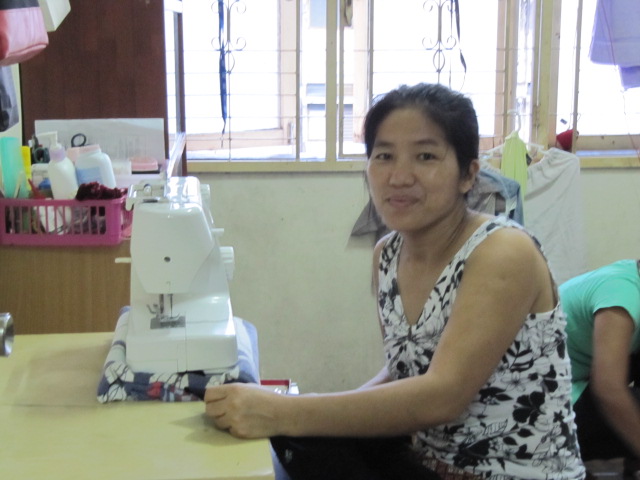 |
| Burmese teacher sewing during school holiday, in order to make clothing to raise school funds. |
 |
| Expat volunteers come in and teach the students hip hop and tennis, in addition to computers, once every week or so. Almost none of the other refugee school visited had extracurriculars like these. This school was connected to expats in a way that really enhanced their education. Note in this photo that there are not consistent teachers for each class, since many of the teachers have to eek out an illegal living outside of the school in order to survive, so the teachers do not work full-time there, but many often live at the school at night. |
September 26, 2012
Our fearless focus group leader, Jennifer, met with Burmese community leaders to get a birds-eye view of the largely hidden Burmese community refugee schools in Kuala Lumpur, Malaysia -- the schools' resources, size, and teacher training. With this information, we can better understand how to help the refugee teachers and students.
Note that there are many more Burmese refugee schools than the 7 schools described below. Burmese refugees make up approximately 85% of the 100,000 refugees in Malaysia. UNHCR-Malaysia
has documented a total of 75 refugee informal learning centers, or
schools, in Malaysia. Based on those numbers, we could estimate that
about 64 of the refugee schools service Burmese students, but there are
no clear numbers from UNHCR on how many of the schools reach out to
specific ethnic groups.
UNHCR reported a couple years ago that there are almost 20,000 refugee
school-aged children in Malaysia who are not allowed access to Malaysian
government schools. Only 30% of school-aged refugees in Malaysia
attend these hidden community learning centers (5,200 students), for less than half a day each
school day, and only until about the age of 12. There are so many refugee
students striving to get an education that the second half of the school day
brings in another set of students for the afternoon session.
Below are notes from Jennifer's meeting with Burmese community leaders. She first documents general observations across Burmese community
schools, then she describes 7 specific schools in more detail:
General
Burmese community school and student information:
- UNHCR pays teachers RM500 (US$165) only if they have UNHCR cards and if there are more than 50 students in the school. Teachers are required to go for training in Harvest for a year and only after 1 year they get compensation from UNHCR. As such, many teachers are not able to make ends meet and find it hard to survive.
- The Burmese leaders report that refugee kids tend to stop schooling by the age of 15 in general. We've heard from UNHCR that most of the refugee students cannot get access to schooling past age 12.
- UNHCR does provide textbooks and materials, a start up, and a one-off grant.
- Students face security issues when they go to school – mostly robberies from local Malaysian kids
- Most Burmese community schools waive the fees if families cannot afford it and if the child is an orphan.
- There are some Burmese learning centres outside Kuala Lumpur – in Cameron Highlands and Penang – but not many and the KL Burmese leaders do not have direct contact with them.
Community 1: Kachin Community (Kachin Refugee Committee)
- Two learning centres with 240 students in total, approximately 30-40 students in one class during one session
- 14 teachers (male & females) in two learning centres, 2 male cooks – all personnel are refugees
- Students’ fees: RM50 for primary school, RM70 for secondary school. Fees include 3 meals and transportation costs.
- Teachers lack experience and ability. Most have not received any training after the basic Harvest Centre training.
- Courses taught are fixed by UNHCR and NGOs
- Rent for the centres are paid by the church – but bills are paid for by the communities.
- Not too sure exactly how many students or teachers in the school but teachers have expressed that they are short of staff as many have been resettled in the last few months.
- Teachers function independent from the community
- Currently the main need for the school is a field and to cover the premises' rental fees
- Students fees: RM30-40
- 1 Learning centre with 60 students
- 2 permanent teachers but only one gets a constant pay from UNHCR, 2 part time volunteer teachers
- Classes are often overcrowded and so they organize outings just to get them out of the classroom
- Due to the overcrowding, student encounter a lot of Health problems – including flu, fever
- Education programs are developed by the community
- Only about 10 students in the community as most of the have been resettled
- The only classes they have are Chinese and Shan language classes
- There are no able teachers in the community to teach other subjects such as maths, science, English.
- Teachers do not get an income from UNHCR
- 1 learning centre with 60 students
- 5 refugee teachers but all are unregistered with UNHCR and have no experience teaching the subjects they have been assigned to teach. An NGO in Ampang also provides part time teachers.
- As the teachers are unregistered they receive no remuneration from UNHCR and are not interested to teach as they are trying to make ends meet themselves. At times they do not turn up for classes.
- 1 learning centre with 80 students
- Teachers are not qualified; Students are Grade 1-5
- Students are not able to speak and write English or communicate with the teachers
- School mainly for adults
- Subjects include: English communication skills, grammar and vocabulary, speaking and listening
- Textbooks come from UNHCR
- Teachers are not registered with UNHCR and all provisions are from the community itself
- There are 17 communities under this alliance with 1400 students
- One learning centre to provide rep – has 174 students
- Teacher compensation is low so many people in the community prefer to go into other professions and the schools face problems in attracting qualified teachers due to this low compensation
Subscribe to:
Posts (Atom)